
Gifts from friends, alumni and other community members enable the University of British Columbia to carry out many outstanding research projects 
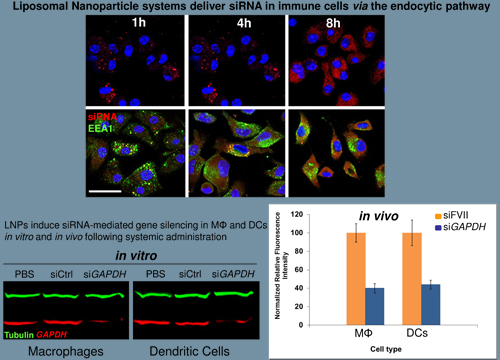 Genc Basha,Tatiana I Novobrantseva,Nicole Rosin,Yuen Yi C Tam1, Ismail M Hafez1, Matthew K Wong, Tsukasa Sugo, Vera M Ruda, June Qin, Boris Klebanov, Marco Ciufolini, Akin Akinc, Ying K Tam, Michael J Hope and Pieter R Cullis (2011). Influence of Cationic Lipid Composition on Gene Silencing Properties of Lipid Nanoparticle Formulations of siRNA in Antigen-Presenting Cells. Molecular Therapy 190 (2011). Doi: 10.1038/mt.2011.190
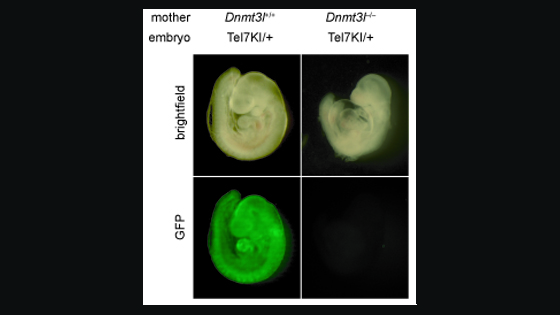
Jones, M.J., Bogutz, A.B., and Lefebvre, L. (2011).An extended domain of Kcnq1ot1 silencing revealed by an imprinted fluorescent reporter. Molecular and Cellular Biology 31(14):2827-2837 (2011). http://dx.doi.org/10.1128/MCB.01435-10
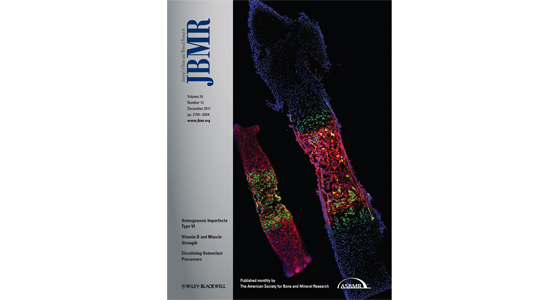
Bond SR, Lau A, Penuela S, Sampaio AV, Underhill TM, Laird DW, Naus CC. (2011). Pannexin3 is a novel target for Runx2, expressed by osteoblasts and mature growth plate chondrocytes. The Journal of Bone and Mineral Research, doi: 10.1002/jbmr.509
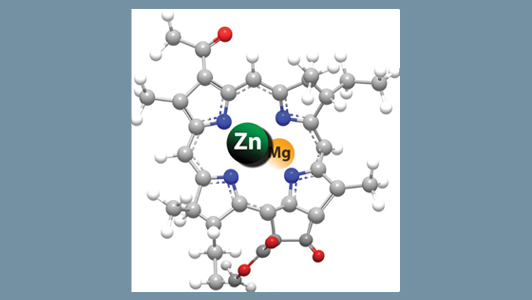 Jaschke, P. R., Hardjasa, A., Digby, E. L., Hunter, C. N., and Beatty, J. T (2011). A bchD (Mg-chelatase) mutant ofRhodobacter sphaeroides synthesizes zinc-bacteriochlorophyll through novel zinc-containing intermediates. The Journal of Biological Chemistry, Vol 286. No. 23. 20313-20322. DOI: 10.1074/jbc.M110.212605
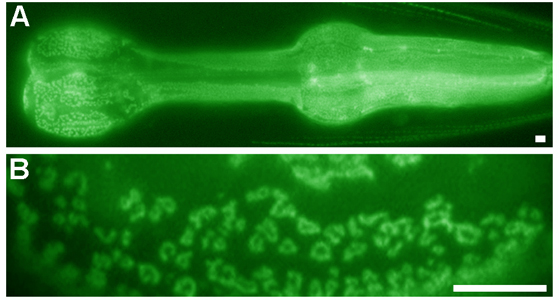 Warner A, Qadota H, Benian GM, Vogl AW, Moerman DG. (2011). The Caenorhabditis elegans paxillin orthologue, PXL-1, is required for pharyngeal muscle contraction and for viability. Molecular Biology of the Cell, Volume: 22(14), Pages 2551-2563 doi:10.1091/mbc.E10-12-0941
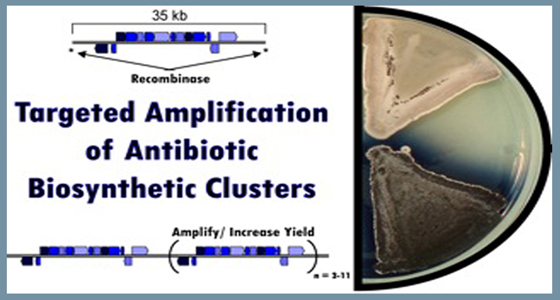
Takeshi Murakami,Jan Burian, Koji Yanai, Mervyn J. Bibb, & Charles J. Thompson (2011). A system for the targeted amplification of bacterial gene clusters multiplies antibiotic yield in Streptomyces coelicolor. PNAS, 108 (38). doi:10.1073/pnas.1108124108
Abstract: A site-specific recombination system was engineered to catalyze tandem amplifications of large genomic segments. The system was able to achieve as many as 12 repeats of the targeted antibiotic synthetic cluster increasing yield > 20 fold (blue pigment). This technology should be broadly applicable to commercially important biosynthetic, degradative and photosynthetic pathways in a wide variety of organisms.
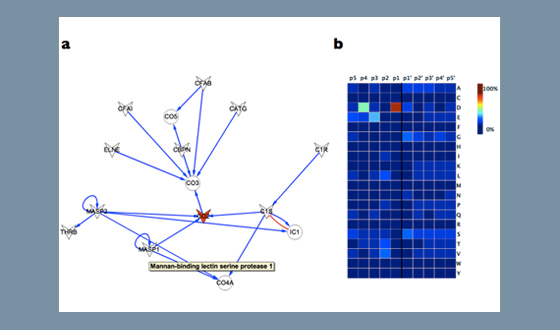 TopFIND, a knowledgebase linking protein termini with function
Authors: Philipp F. Lange and Christopher M. Overall, Lab of Christopher Overall, The Centre for Blood (CBR) Research Group, Department of Biochemistry and Molecular Biology & Oral Biological & Medical Sciences
Published in Nature Methods ; doi:10.1038/nmeth.1669
Abstract: Protein termini embody plentiful information on the proteins functional state and competence. We developed TopFIND, a knowledgebase providing integrated information on translated protein N and C termini, their formation by proteolytic processing and their amino acid modifications. Identification of a loss of proteolytic processing by caspases as possible molecular mechanism underlying a number of somatic cancer causing mutations in p53 showcases its application for hypothesis generation.
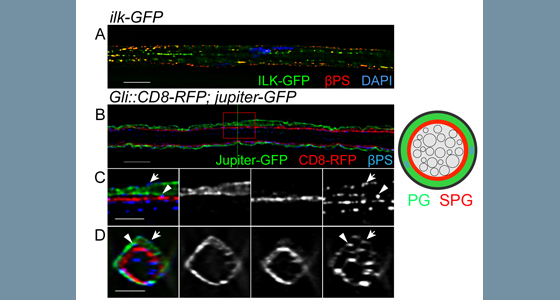
Integrins are necessary for the development and maintenance of the glial layers in the Drosophila peripheral nerve
Authors:Xiaojun Xie and Vanessa Auld, Lab of Vanessa Auld, Cell and Developmental Biology Research Group, Department of Zoology
Published in Development; doi: 10.1242/dev.064816
Abstract: Peripheral nerve development involves multiple classes of glia that cooperate to form overlapping glial layers paired with the deposition of a surrounding extracellular matrix (ECM). The formation of this tubular structure protects the ensheathed axons from physical and pathogenic damage and from changes in the ionic environment. Integrins, a major family of ECM receptors, play a number of roles in the development of myelinating Schwann cells, one class of glia ensheathing the peripheral nerves of vertebrates. However, the identity and the role of the integrin complexes utilized by the other classes of peripheral nerve glia have not been determined in any animal. Here, we show that, in the peripheral nerves of Drosophila melanogaster, two integrin complexes (αPS2βPS and αPS3βPS) are expressed in the different glial layers and form adhesion complexes with integrin-linked kinase and Talin. Knockdown of the common beta subunit (βPS) using inducible RNAi in all glial cells results in lethality and glial defects. Analysis of integrin complex function in specific glial layers showed that loss of βPS in the outermost layer (the perineurial glia) results in a failure to wrap the nerve, a phenotype similar to that of Matrix metalloproteinase 2-mediated degradation of the ECM. Knockdown of βPS integrin in the innermost wrapping glia causes a loss of glial processes around axons. Together, our data suggest that integrins are employed in different glial layers to mediate the development and maintenance of the protective glial sheath in Drosophila peripheral nerves.
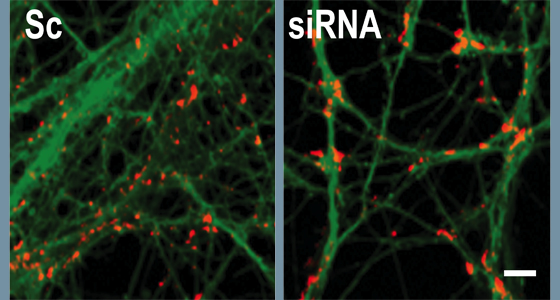 Progranulin deficiency decreases gross neural connectivity but enhances transmission at individual synapses
Authors: Cynader M, (Departments of Neurosurgery and Ophthalmology and Brain Research Centre, UBC), S Tapia L, Milnerwood A, Guo A, , Yoshida E, Vasuta C, Mackenzie IR, Raymond L, Cynader M, Jia W, Mills F, Bamji SX.(University of British Columbia, Vancouver), Lab of Shernaz Bamji,Cell and Developmental Biology Research Group,Department of Cellular & Physiological Sciences
Published in The Journal of Neuroscience, 3 August 2011, 31(31):11126-11132; doi:10.1523
Abstract:Frontotemporal dementia (FTD) has been linked to mutations in the progranulin gene (GRN) that lead to progranulin (PGRN) haploinsufficiency. Thus far, our understanding of the effects of PGRN depletion in the brain has been derived from investigation of gross pathology, and more detailed analyses of cellular function have been lacking. We report that knocking down PGRN levels in rat primary hippocampal cultures reduces neural connectivity by decreasing neuronal arborization and length as well as synapse density. Despite this, the number of synaptic vesicles per synapse and the frequency of mEPSCs are increased in PGRN knockdown cells, suggesting an increase in the probability of release at remaining synapses. Interestingly, we demonstrate that the number of vesicles per synapse is also increased in postmortem brain sections from FTD patients with PGRN haploinsufficiency, relative to controls. Our observations show that PGRN knockdown severely alters neuronal connectivity in vitro and that the synaptic vesicle phenotype observed in culture is consistent with that observed in the hippocampus of FTD patients.
Gifts from friends, alumni and other community members enable the University of British Columbia to carry out many outstanding research projects